More Carrying Debt into Retirement
Visit Original Squared Away Article
No matter how you measure it, older Americans are falling deeper in debt.
The number of people in their 60s who have debt has grown from just under half of that age group in 1998 to nearly two out of three in 2010. And their debt, as a share of their assets, has surged during that time from 10 percent to 18 percent.
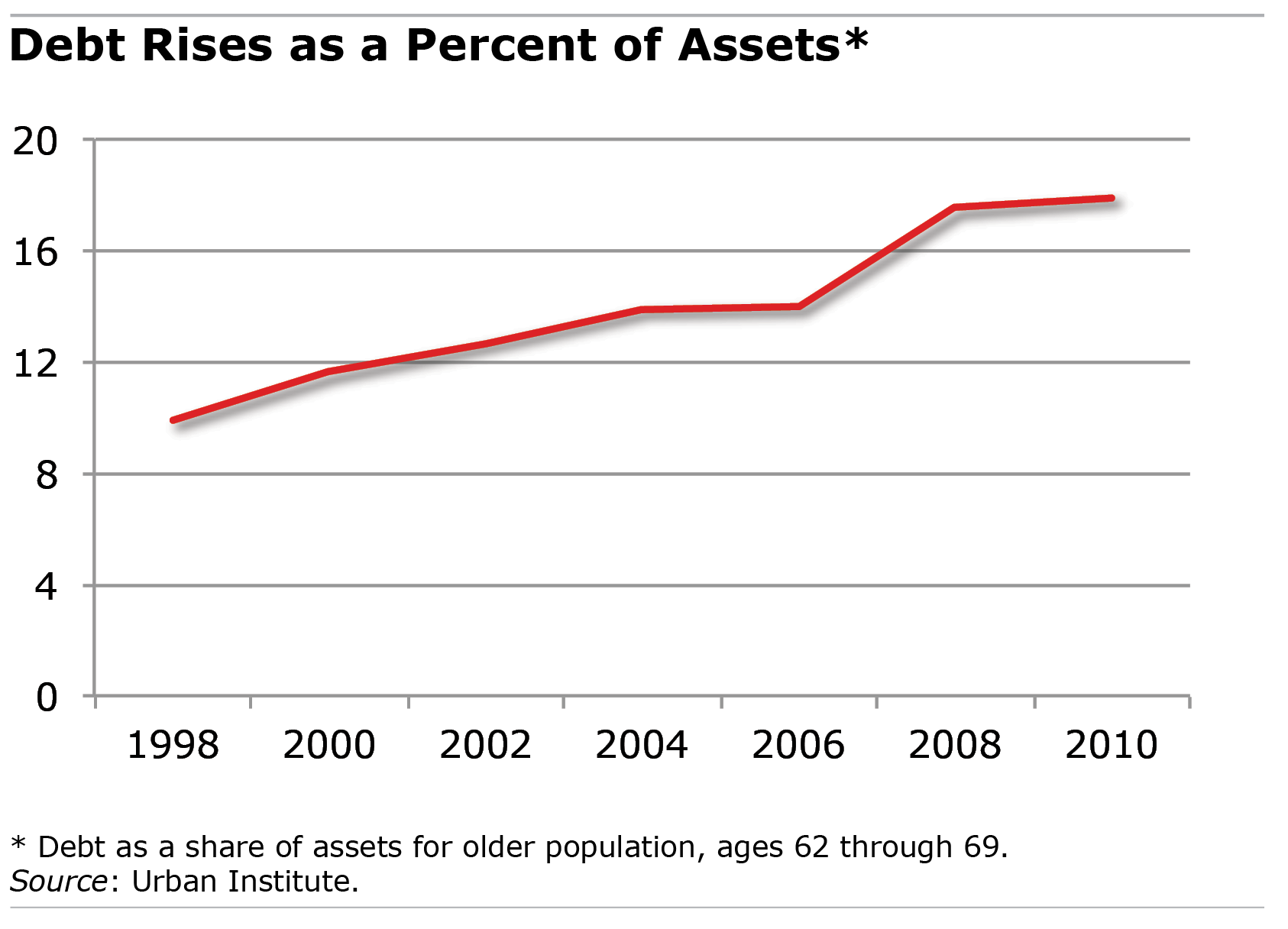
Debt is becoming increasingly common among older people, regardless of their level of income, according to Urban Institute researchers, who presented their findings at the August meeting of the Retirement Research Consortium.
Among individuals with incomes that place them in the top third of incomes, the share of older people in debt increased from 57 percent to 70 percent between 1998 and 2010 – a 13 percentage point rise. But that share rose by 17 percentage points for middle-income and by 14 percentage points for low-income people. In all three income groups, the amounts owed also rose.
One major reason more older Americans have debt is mortgages: more of them have one, in part because they’re paying them off more slowly than they once did. Mortgage balances have also increased. One possible explanation for these trends is that many homeowners traded up during the housing boom and took on larger mortgages. An unrelated study estimates that 17 percent of mortgage borrowers who are close to retirement age owe more than their house is worth.
Other factors – not necessarily negative – are also swirling beneath the surface that may explain what’s driving the growing prevalence of debt. More boomers with thriving careers want to work longer. So, the great incidence of debt among households in their 60s doesn’t always mean a higher incidence of retiree debt.
Taken alone, the debt trend among older Americans is striking enough. But it may be having an impact on baby boomers’ decisions about when they will retire.
People in their 60s who owe money, particularly if they have a mortgage, are increasingly likely to retire or start collecting their Social Security benefits later, according to the Urban Institute’s research, which is believed to be the first to confirm a link between debt and these major life decisions.
Much of the talk in retirement circles seems to center around whether aging baby boomers have enough money in their 401(k) retirement accounts.
But debt is a big part of the story.
The research cited in this post was funded by a grant from the U.S. Social Security Administration (SSA) through the Retirement Research Consortium, which also funds the Squared Away blog. The opinions and conclusions expressed are solely those of the blog’s author and do not represent the opinions or policy of SSA or any agency of the federal government.